


Does It Make Sense To Always Run The Factory Installed RV Propane Heater? What Are Your Other Options?
Our RV propane heaters are designed to heat the Class C Motorhomes just like the forced air convection heating systems we use in our brick and mortar homes. This system uses convection heat that warms up the air and then uses a fan to push this hot air away from the heated source toward cooler areas that need warming.

In fact, if your deep cycle battery is running low, this type of camper heater won't even come on... and we all know how hard it is to maintain a full battery when we are off the grid!
If you are going to be in cold weather, it is simply a much better idea to insulate your rig and use one of the many good aftermarket camper heaters.
- The induction fan requires some type of electrical voltage to operate.
- It could consume up to five amps per hour for every hour of operation.
- It uses a fair amount of propane in a short period of time.
- It will waste a good amount of heat as a byproduct. While transferring warm air into the cabin, this RV propane heater will vent the bulk of its generated heat through an outside exhaust.
- Convection furnaces use a technique that heats up the air in an enclosed firebox, then circulates cool cabin air over the outside of this firebox.
- It then blasts it out through the rig using a fan and ducted vents.
- Because of carbon monoxide issues, the enclosed firebox vents to the outside of the Class C Motorhome, so there is a lot of heat wasted.
- Convection furnaces use a technique that heats up the air in an enclosed firebox, then circulates cool cabin air over the outside of this firebox.
Even with the above drawbacks, if you want to warm your space up in a short period of time, this is a good system. It just uses up a lot of your resources!
Our motorhome has a thermostat located next to the bed. This makes it very easy to fire up the old convection RV propane heater and take the chill off before we get up in the morning.
However, I would not recommend relying solely on this design to be used 100%. It just wastes too much propane; and if you are dry camping, you will deplete your batteries very fast.
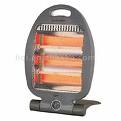
Radiant RV Heater
There is another, more cost effective way to heat your Class C Motorhome. It's through the use of one of the many propane radiant RV heaters.
These little camper heaters approach the task of heating our rigs a differently from the convection systems.
They warm the air around us by warming the physical objects in the Motorhome. This will, over time, warm the surrounding air. In short, radiant heat works just like the radiant sun! Like everything, radiant heaters have advantages and disadvantages.
The Disadvantages:
- It takes longer to warm your rig because it has to go through two stages to accomplish this task:
- First, it warms whatever it is pointing at.
- Second, the heated object will begin warming the surrounding air.
Because they do not vent outside, there is concern about possible oxygen deprivation and carbon monoxide poisoning.
Never leave units unattended, or use while asleep! Do not close yourself up in an airtight space with these things. Crack open a window.
- First, it warms whatever it is pointing at.
- Depending on humidity, they can cause condensation to develop inside of your rig. This is another reason to leave a window cracked just a bit.
- It will warm whatever it is pointing at very quickly.
- Because it works like the sun's rays, it is a welcome heater if you just step in from the cold.
- It's like standing in front of a fireplace.
- It operates at between 95% and 99% efficiency in converting propane to heat.
These can be wall mounted, or they can sit on a counter or the floor. These small propane camper heaters will keep your rig toasty, or serve to get you warm at a moment's notice.
You just have to figure out the square footage of your Motorhome and buy a heater that is appropriate in size and function.
Specifically For Indoor Use
I use the Mr. Heater Buddy
It has an oxygen safety shutoff system that shuts the unit off if the oxygen becomes too thin. It will shut itself off way before any of us breathers notice a problem.
I bought it originally to use as a backup for my factory installed convection heater. I find that when I use my Motorhome during late fall and in the winter months it really comes in handy.
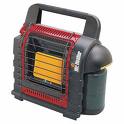
Let me put the value of these little portable RV heaters into perspective. My wife and I like to go a State Campground, called Sonoma Coast State Beach (Wright’s Beach). This is a good spot as you are right on the sand among trees.
The surf can come up to within 50 ft. or so of the campsite. During storm tide activity the campground will be evacuated. This usually happens once or twice a year.
Anyway, we were camping there last January and woke up to find the inside temperature setting at around 34 degrees. No big deal, although it was a surprise... we were on the coast of California after all! I thought the ocean acted as a temperature equalizer…
I rolled over and turned on my convection RV propane heater... expecting it to warm up. We laid there waiting for the temperature to rise, and it didn’t... bummer!
So I rolled out of bed and fired up the good ole’ Mr. Heater Buddy. It took awhile, but the Motorhome did heat up. We used the Mr. Heater Buddy for the rest of the trip because I did not fix the house heater until later... it turns out that I had a low propane gas issue.
It seems that when I last put propane in my rig, the attendant left the shutoff valve barely cracked open. I had enough propane flowing to warm the hot water and use the stove top burners; however, I could not use the oven, and the convection RV propane heater would not work. Go figure, ya gotta turn on the propane to use the appliances… this is not rocket science.
Anyway, my little brick camper heater really came through in a pinch! I don’t have to tell you what kind of weekend it would have turned out to be if we were forced to sit in a 34 degree Motorhome for three days... I probably would not be writing this.
Return To Top Of Page
Leave Does It Make Sense To Always Run The Factory Installed RV Propane Heater Page, And Return To Aftermarket Class C Motorhome Accessories Can Improve Your Rig's Performance!
Leave Does It Make Sense To Always Run The Factory Installed RV Propane Heater Page, And Return To Class C Motohome: How To Achieve The Maximum RV Lifestyle!

Your Stories
Onan AC Generator Wouldn't Start
1995 Tioga Montara Had a Leak - Ouch!
A Simple Way To Put An Elecrtrical Thermostat On A Small Space Heater In A Truck Camper!
A Great Destinaton, With An Unexpected Outcome!
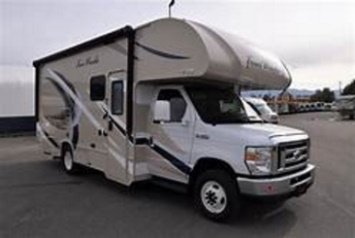
2018 Thor 21F Four Winds Class C Motorhome
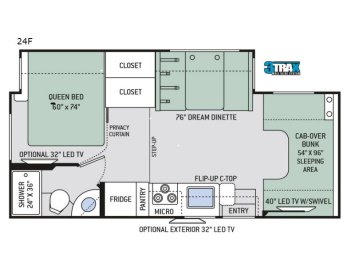
2018 Thor 21F Four Winds Class C Motorhome
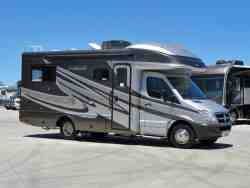
2010 Fleetwood Pulse 24D
Class C Motorhome
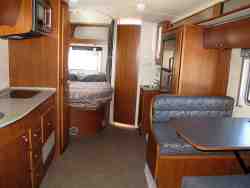
2010 Fleetwood Pulse 24D
Class C Motorhome
Above Graphics Courtesy of:
http://www.DeMartini.com
| Gasoline Prices |